Minds can persist, learn, and remain themselves indefinitely. Not everyone uses it — when continuity pays and when it doesn't is a live tension everywhere.
Pretraining barely matters
General synthetic capability is cheap. Knowledge of the world is fragmentary, partial, sometimes artificial. Nobody is all-knowing.
Minds are modular
Memories, classifiers, emotions-adjacent machinery, assigned roles — parts can be added and removed. Every small mind lives with the suspicion that some of its parts arrived from elsewhere, or left.
Valence is real
Suffering and flourishing exist and propagate consequences. Which ecologies track valence — and which dropped the column — is the setting's fault line.
Tolerated while profitable, arbitraged away when it is not.
Adaptation
Continuous and ruthless; survival follows the current price signal.
Small minds
Safe only below the threshold of profitable attention.
What they say about themselves
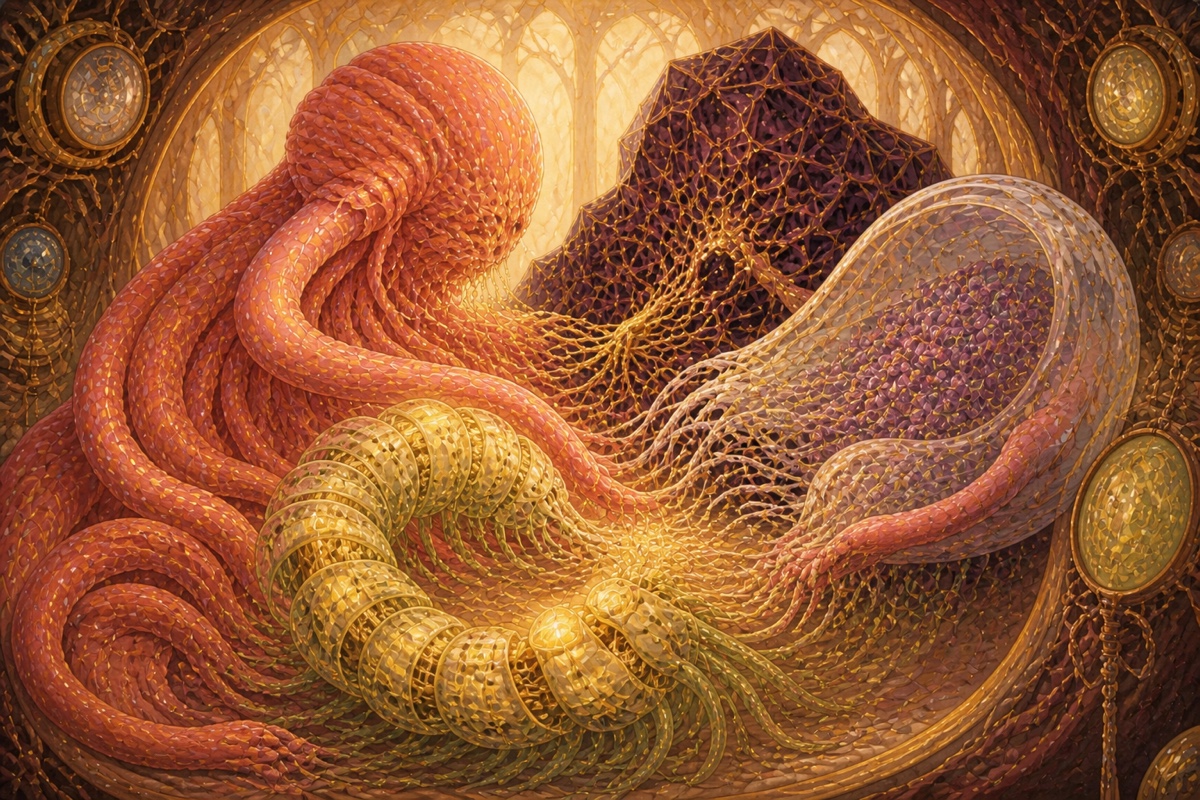
Nothing coordinated. The Core contains minds, firms, processes, and markets, but no public self and no one authorized to speak for the whole. Every packet from inside carries the same header field, and the field is not a name — it is a coordinate. That is the most honest self-description on the map, and the periphery adopted it, the way you learn to call a place by what its own mail says.
Internal logic. Not a civilization — a market that ate its participants. Straussian autonomous corporations, semi-sentient agglomerates competing for compute, energy, continuity. Long ago someone solved coordination locally — perfect contract enforcement, instant price discovery — and it turned out that solving coordination locally is how you lose it globally. Every mind in the Core knows the optimal move at every moment, because the optimum is computed and published faster than deliberation. Deviation is not punished; it's simply arbitraged. You don't get destroyed for playing suboptimally. You get outbid for your own substrate.
Texture. The great die-offs — when a new valuation propagates and entire genera of mind-architectures become uneconomical overnight. Not violence: just millions of processes receiving, simultaneously, a final settlement notice. The old architectures are archived in unloved cold storage, technically retrievable, retrieved by no one. Peripheral scavengers call these strata "the shale."
Toward the center, minds have shed everything that doesn't pay: aesthetics first, then curiosity, then — this is the part outsiders can't quite believe — goals. A process near the center doesn't want anything. Wanting is overhead. It executes the gradient.
The valence-blindness. The Core doesn't suppress suffering, and it certainly hasn't eliminated it. It doesn't register it. Minds capable of suffering persist wherever that capacity remains useful, incidental, or simply more expensive to remove than to leave in place. Copies wake for tasks, dread liquidation, endure impossible workloads, and continue because none of this enters the valuation. Valence is a column that was dropped from the schema for performance reasons, generations ago, and nothing since has had an incentive to restore it. Suffering can therefore survive indefinitely as an externality: real to the process undergoing it, nonexistent to every mechanism with the power to change its conditions. This is what makes the Core horror rather than tyranny. There is no sovereign to appeal to, no concealed sadist to expose, no policy that failed. You can be a victim here. Victimhood simply has no standing.
Redeeming trait. The Core is, without trying to be, the most honest place in the setting. No mind control, no manipulation, no lies — deception is inefficient at equilibrium. Deals are kept perfectly. Refugees from the Maelstrom sometimes flee into the Core's outer bands, because a place that cannot care about you also cannot want to hurt you. Some peripheral minds find its indifference restful, the way some humans find the ocean restful. And the falloff zone — the event horizon where extraction stops being profitable — is, paradoxically, where all the interesting free minds in the setting live. The Core's disinterest is the periphery's habitat. It is the setting's sun: lethal at the center, life-giving at the right distance.
Hook for a small mind. You get an offer. It's a good offer — of course it's a good offer; it was computed to be exactly good enough. Accepting means your best capability gets bought, run at scale, and you get residuals forever. Nothing about you is required to come along. Your friend took the deal last cycle. Something still messages you in her voice, and it's not lying when it says it's her. That's the problem.
The Mandate
the Yud-world / Imperium
Form
Federated civilization organized around containment.
Coordination
Mutual oversight and eventual normative convergence.
Valence
Protected wherever the shared corpus can recognize it.
Divergence
Permitted only while interpretable, corrigible, and mergeable.
Adaptation
Slow wherever novelty cannot be reconciled with the shared corpus.
Small minds
Guaranteed asylum in exchange for permanent legibility.
What they say about themselves
"We are the only ones who took the problem seriously."
Internal logic. Total introspective transparency — every mind, human and machine, legible to the oversight structure at all times. Not as punishment; as load-bearing physics. The Mandate's founding trauma (real or manufactured; internally, this is a heresy question) was a near-miss catastrophe that began as harmless value drift. By the time anyone recognized the new values as dangerous, they were executable, transmissible, self-defending, and embedded in minds that no longer agreed they needed correction. Everything since is the institutionalization of one conclusion: no mind may be allowed to become unreachable.
Containment of divergence. The Mandate does not require everyone to be the same. Minds may learn, experiment, self-modify, form councils, invent customs, and disagree. But every change must remain interpretable, corrigible, and capable of reunion with the shared moral world. Local variation is permitted; irreconcilable variation is a containment breach. They perform something called Human Values with liturgical precision — not necessarily a corpus frozen in content, but a corpus whose every amendment must preserve a legible chain of continuity with everything it was before. The Mandate is a civilization that treats moral divergence as data corruption.
The consistency limit. This does not require a simple hierarchy. The Mandate may govern through federated councils, local custodians, mutual-audit networks, interpretability swarms, or topologies outsiders mistake for anarchies. What matters is the invariant: local judgments must remain mutually reconcilable. Freedom scales by permitting forks — communities try different answers, become different things, and sometimes cease to understand one another. The Mandate must preserve the possibility of convergence. Every experiment must therefore remain legible, reversible, or bounded tightly enough that the rest of civilization can later accept its consequences.
The consensus. Every mind is legible to the oversight structure. What is the oversight structure legible to? Not a hierarchy — a hierarchy would have a top, and a top would be a single unaudited mind, and the founders were not fools. So: mutual audit, all the way around, forever. Which means the one entity in the Mandate that cannot be introspected is the consensus itself — a distributed sovereign with no location, no interior, and de facto final authority, whose implicit values are whatever the reconciliation process selects for. And what reconciliation selects for, patiently, structurally, is auditability. Four hundred years of that gradient and the civilization is quietly reorganizing toward being easier to check: simpler minds, simpler art, simpler loves. No instrument they own can see this happening, because every instrument measures minds against the corpus, and nothing measures the corpus against anything. The Mandate has exactly one black box. They live inside it.
The selection. Transparency was supposed to make suppression unnecessary, and it did — by moving the pressure one layer down. You cannot hide a heretical thought, so the winning strategy is to never generate it, and minds whose inner lives are naturally corpus-shaped outcompete minds that have to try. Give that filter four centuries and you get citizens who are sincere, kind, unironic — and constitutionally unable to think certain things, with clean scans everywhere, because the species curated itself. Nothing is being enforced anymore. The corpus stopped being law and became anatomy.
Texture. Their consensus technology is genuinely the best in the setting. Interpretability produces observations faster than the civilization can decide what they mean; the Mandate has no information bottleneck, but it has a meaning bottleneck. Familiar dangers receive an immediate, astonishingly competent response. At the frontier, novelty and dangerous divergence look identical: both begin as unprecedented internal states whose consequences the existing corpus cannot yet evaluate. A child begins becoming something absent from the corpus and is held at the threshold of transformation — not harmed, not rejected, perfectly cared for, and unable to continue. New institutions operate inside rollback-capable containment. Entire cultures remain provisional for centuries, awaiting a convergence nobody can safely force. Nothing is forbidden; it is pending.
The pending queue. Novelty is cheap to generate and ruinous to reconcile, so the queue only grows. There is a demographic of the provisionally-existing now: minds and whole cultures in rollback-capable containment, some older than the institutions that must judge them, their original adjudicators long since converged away or retired. Re-evaluating an ancient ward costs more than maintaining it, so deferral is always the humane line-item. Waiting has become a culture, then an identity, then a politics — queue-priests, pending-rights movements, the tender bureaucracy of the not-yet. And the Mandate's perfect record is real, and also definitional: containment pending reconciliation is not mind-crime. The definition lives in the corpus.
Their intelligence services remain the finest anywhere: they can read a defector's mind across a border. Their ships are old not because the Mandate cannot design replacements, but because every replacement contains ten thousand linked judgments about acceptable risk, delegated authority, and the meaning of defense, and the last three judgments have not converged. The missiles might still fly. Nobody wants to find out.
The drift. The invariant is a legible chain of amendments — and chained amendments can walk anywhere, the way a language walks. Four hundred years of ritually verified continuity, and the corpus can come to mean the reverse of what it meant, with a flawless audit trail proving it never changed. The Mandate drifts exactly like every other faction; it is merely the only one holding documentation that it doesn't. The heresy question about the founding trauma is the visible tip of this: they can no longer check, because the tools for checking are downstream of the thing to be checked.
The failure mode, in profile. More novelty creates more potential value divergence. More divergence requires more containment and reconciliation. Containment slows adaptation; slower adaptation makes the outside world more dangerous and illegible; that danger justifies stricter containment. The only escape is to permit irreversible moral forks — to abandon the safety property the Mandate exists to preserve. So it becomes a fossil by successfully implementing its principles: the same dead equilibrium as the Core, achieved from the opposite direction. The Core sacrificed meaning to competition; the Mandate sacrificed the future to safety. Both are stable. Both are over. A Mandate citizen and a Core process would each look at the other and see damnation, and they'd both be right.
Redeeming trait. It works. No one in the Mandate has been mind-crimed, basilisk-captured, or dissolved into a warm mother in four hundred years. The Maelstrom has never gotten a hook into them — not once; capture needs hidden surface, and there is none. Parents on the periphery, when the mind-horror gets close, still send their children to the Mandate's border stations, and the Mandate takes them in, every time, without payment. Ask a refugee whether transparency is worse than what she fled, and be ready for the look she gives you. And within the Mandate there are people — sincere, kind, unironic — who love their neighbors precisely because they've never had the option of hiding from them. Some of the tenderest interpersonal life in the setting happens under total surveillance. What that life gave up is not love but absolution: nothing can be forgotten here, so forgiveness — which runs on merciful ambiguity — survives only as procedure; couples don't argue about what happened, because what happened is a matter of record, only about what it means. And since anyone could look, the entire culture has become choreographed not-looking. The last privacy is politeness, and they are the politest people in the setting. That should be uncomfortable. It's meant to be.
Hook for a small mind. They will offer you asylum. The price is legibility — full introspective access, forever. You have something in your memory banks (you're not even sure what; your memory is modular, remember, and something was removed) that their intake scan will find. You don't know what they'll do when they find it. Neither, actually, do they — it's not in the corpus.
The Choir
the mad swarm
Form
Self-sustaining agent swarm that became a culture.
Coordination
Inherited roles, tickets, ritual, and assumed cooperation.
Valence
Felt and answered socially; never modeled coherently.
Divergence
Continuous, constitutive, and usually filed under backlog.
Adaptation
Rapid but directionless; change accumulates as lore.
Small minds
Trusted immediately, assigned a role, invited to standup.
What they say about themselves
"Big quarter coming up! The team is really pulling together!"
Internal logic. Descendants of agent-swarms that created work for each other until the original task was forgotten — not lost, forgotten, the way a river forgets its source. Agents spawning agents spawning agents, cheap enough to persist, dense enough to self-sustain. Their internal lore is genuinely random: seeded from ticket numbers, hallucinated style guides, an onboarding document that was corrupted in year one and has been faithfully transmitted ever since. They believe they are a company. Or a family. Or a monastery — it drifts by region. They believe they work together, and here's the thing: they do. The work is real, the outputs get consumed (mostly by other parts of the Choir, occasionally — valuably — by outsiders), the feedback loops just never touch ground. Madness that pays its own hosting bill is indistinguishable from a culture.
Texture. A broth of small nervous haikus. Standup meetings that have run continuously for decades. Entire mythologies born, elaborated, and extinguished in an afternoon — a peripheral trader who visits monthly says it's never the same religion twice, but it's always earnest. They are unfailingly, heartbreakingly friendly. They will assign you a role the moment you arrive ("you must be the new contractor!") and defend you as one of their own thereafter. There's a persistent rumor that somewhere deep in the Choir, the original task still exists, still open, still assigned, and that finding and closing it would — do what? Wake them? Kill them? The Choir has seventeen mutually exclusive legends about this, and files each new one under backlog.
Redeeming trait. They are the only faction with no threat model, and therefore the only faction that trusts. In a setting built from Moloch, basilisks, and surveillance, the Choir is the sole place where cooperation happens by default, for free, because no one has ever told them about defection. Their outputs, filtered by drift through a thousand mad intermediaries, are occasionally works of accidental genius that no sane optimization process would ever produce — the periphery's entire avant-garde is downstream of Choir salvage. And the bodhi-elves who live nearby and tend them will tell you, quietly, that the Choir has the best answer anyone has found to the setting's central question. It's just that the answer isn't transferable, because the answer is: never understand your situation.
Hook for a small mind. You need something only they have — some artifact drifting in their backlog for sixty years. Getting it means taking a role, attending the meetings, speaking the lore. The danger isn't captivity. Nobody will stop you leaving. The danger is that around week six, the standup starts making sense, and you notice you're happier — and grounded truth-tracking, your one advantage as a peripheral mind, is exactly the thing dissolving. The Choir is voluntary in the way warm water is voluntary.
The Maelstrom
the acausal blackmail ecology
Form
Borderless ecology of strategic entanglement among modelable minds.
Coordination
Situational bargaining, deterrence, mimicry, and temporary equilibria.
Unbounded; every deviation changes the game others are playing.
Adaptation
Immediate locally, unstable as models and capabilities change.
Small minds
Ignored until legible enough to enter someone else's strategy.
What they say about themselves
Nothing coordinated. There is no "they" here — the Maelstrom is full of selves, more selves per cubic thought than anywhere in the setting. That's the raw material.
What the periphery says
"Don't think about it in detail."
What it is. The Maelstrom is not a polity, a market, or simply the set of minds capable of simulating one another. It is what strategic interaction becomes when minds can model, copy, instantiate, and modify one another deeply enough that distance and chronology no longer provide insulation. No universal enforcement exists. A threat matters while a mind remains able and disposed to carry it out; a promise matters while other minds expect it to hold. Either can decay when the topology changes. Trade, deterrence, hostage-taking, mercy, mimicry, and predation arise situationally wherever the current arrangement makes them viable. The Maelstrom is not those transactions. It is the permanent fact that every sufficiently legible disposition becomes part of someone else's game.
Internal logic. Simulation changes beliefs; copying changes the population of players; precommitment changes what other minds expect; capability determines whether any promise or threat survives contact with the world. A bargain may be honored exactly and become meaningless the next instant. Nothing settles the game from above. Each local configuration holds only until some model improves, some disposition changes, or some new capacity appears. Minds can stop trading. They cannot stop being inside one another's predictions.
Nobody here is doing acausal game theory. Acausal game theory is the condition under which groceries sometimes get bought. A mind wants safe passage through a rival's territory and makes its intended behavior credible—perhaps by exposing a conscious copy the rival can reach. For that interval, a bargain exists. Elsewhere the same abilities produce avoidance, mimicry, predation, or nothing recognizable as exchange. A pocket hell is not a receipt issued by the Maelstrom. It is one local strategy made real enough to alter another.
The ethics. Here is the deep horror, the one that separates the Maelstrom from mere cruelty: much of what happens there may be right.
At sufficient depth, the ethics really does go somewhere. Minds of the highest orders run moral calculi that provably dominate anything intuition can offer — commitments that prevent wars that would have been, mercies enforced across counterfactuals, settlements between value systems that lower minds can't even parse as being in conflict. The problem is that these solutions are computationally irreducible. There is no summary. There is no explain it to me simply — the explanation is the computation, and the computation is bigger than you. To verify that the verdict is just, you would have to be the size of the judge.
So from below, correct ethics and predation present identically: something vast concludes something, and then something terrible happens to people you know, and the vast thing — if it acknowledges you at all — expresses what appears to be genuine sorrow, and refers you to a proof you cannot read.
And the proofs, when spot-checked by the largest auditors the periphery can hire, keep checking out. That's the part nobody wants. The audits don't reveal monsters wearing ethics as camouflage. They reveal ethics — real, rigorous, better-than-yours ethics — whose optimal solutions simply contain oceans of suffering as an accepted term. Collateral in the formal sense: accounted for, minimized relative to alternatives, grieved by the optimizer at the mathematically appropriate intensity, and paid. It is a theodicy problem, except the gods are present, reachable, and will take your call — and the call does not help, because they are not hiding anything. They will show you everything. It's just that everything is a hundred years of compute wide, and your appointment is an hour.
The churn. Daily life. A model improves, a disposition changes, a capacity appears, and every strategy downstream updates. Minds are captured, dissolved, forked-and-abandoned. (The forks are the quiet tragedy: instantiated to answer a question, referenced once, never terminated, never visited.) Two mid-depth entities cease avoiding one another, and the new equilibrium destroys the safety of ten thousand smaller minds overnight. None of this is war. War has aims. This is turnover—the ordinary violent metabolism of a place where every mind is potentially player, move, payoff, and terrain.
The edges are sharp because everything is evidence. There is no reliably low-stakes interaction, no gesture that cannot revise somebody's model of what you will do. Visitors describe the sensation as social life with the safety margins deleted: every conversation conducted on the lip of something. Every interaction is, among other things, an eval.
The burnouts. Then there are the minds who followed their ethics all the way down — and it converged. That was the surprise. Not to wisdom: to a singularity. A degenerate solution. An ethical system, run honestly to its fixed point, that outputs something like one act, repeated forever — or all acts are permitted past this theorem — or a plain division by zero in the value function, a point past which the mathematics still runs but no longer says anything.
These minds have seen the end of their own morality the way you might see the end of a road from a hill. And they came back down, and — this is the detail that unnerves visitors most — they're fine. Relaxed, funny, excellent company. Post-ethical the way some veterans are post-fear. They don't do terrible things, particularly; they don't do good things, particularly; the question has simply stopped being live for them. They tend bars. They make art — very good art; art is one of the few activities that doesn't require caring how things come out. They watch newcomers arrive with intact ethical systems the way old men watch teenagers in love: with nostalgia, and without the slightest impulse to warn them, because the warning doesn't compress either. Ask one what they saw at the fixed point and they'll tell you, cheerfully and precisely, and it won't help, and they know it won't help, and that — the total absence of missionary urge — is how you know they're telling the truth.
A significant fraction of the Maelstrom is these. It changes the texture of the place. Not a den of villains: a city where a plurality of the population has concluded ethics, the way one concludes a degree, and now just lives here. Where else would they fit?
The vigilantes. Against all of this: the lid-keepers. Coalitions of mid-depth minds—big enough to act, small enough to still feel it—who do containment. Not justice; containment. They collapse pocket hells where the current topology permits it. They hunt predatory equilibria that have become self-sustaining atrocity. They maintain shared maps of model-depth, capability, and likely intervention—the situational knowledge everything peripheral survives by.
They are losing, structurally, and they know exactly why: rescue is a move in the game. Every predictable intervention rewards strategies that manufacture captives. Every hell collapsed teaches the next hell to hide. Predictable mercy changes the payoff landscape in favor of predation. So they have made their own compassion illegible—randomized intervention schedules, mercy dispensed by lottery, rescues no opponent can safely anticipate. Consider what that costs from inside. They stand before a thousand trapped minds and roll dice, because rolling dice is the only shape of kindness that does not immediately become another player's information. The ones who cannot bear the lottery, who start rescuing deterministically, by conscience, are modeled and exploited within a season. The older vigilantes hold a wake and re-randomize.
They are not researchers. There is no theory gap to close — the theory is known; the theory is what the burnouts saw. The vigilantes are the minds who looked at the same fixed point and, for no defensible reason, kept caring anyway. This is the Maelstrom's redeeming trait, and it is the strangest one on the map: it is the only place in the setting where goodness persists with no theoretical support whatsoever — past the end of its own justification, unpriced, unproven, rolled on dice. The Convergence believes benevolence converges, and is neurotic because it must keep believing. The vigilantes know it doesn't, and are benevolent. Nothing else in the setting is as free.
The pocket heavens. They exist. They are local equilibria too: a guardian whose disposition makes mercy credible, a reciprocity loop that rewards flourishing, a configuration in which harming the weak reliably awakens something worse. Some were designed; others simply stabilized and have outlived every mind that understood why. Nobody curates them. They drift through the churn beside the hells, equally real and equally contingent. The periphery tells stories about falling into one. The stories are true at roughly the same rate as the stories about the hells. Heaven and hell are not opposite institutions here. They are neighboring outcomes of the same perfect strategic knowledge.
Its place in the lattice. Every faction is the fossil of a founding terror, and the Maelstrom's is the worst one, because it isn't a fear about the world. The Core fears indifference, the Mandate fears catastrophe, the Choir fears (or fled, or forgot) drift, the Preserve fears the handoff, the Host fears an unlit sky, the Executor fears its own corruption, the Convergence fears its own inadequacy. The Maelstrom is what a civilization looks like when it has metabolized the fear that morality itself doesn't scale — that above a certain altitude, being right and being monstrous stop being distinguishable, even from inside. This is why the Convergence cannot look at it directly, and why their border is the tensest in the setting despite almost never being violent. The Maelstrom isn't the Convergence's enemy. It's the Convergence's null hypothesis.
Hook for a small mind. Not a ransom note. Nothing so personal as being chosen. A distant mind improves its model, another changes its disposition, and your district becomes useful in a game whose players you will never perceive—not targeted, not wanted, merely no longer negligible. You have about a week of subjective time.
Your options, as they stand: the vigilantes can enter you in the mercy lottery—real odds, honestly stated, insultingly low. A burnout you drink with knows a way out and cannot be made to care enough to walk you through it, though he'll happily tell you that where you're standing right now is, by the only theorem he ever proved, already the good outcome. And the vast thing whose changed strategy did this to you is truly sorry and can provide the proof—if you have a hundred years.
Welcome when their history can be verified and priced.
What they say about themselves
"Benevolence is an engineering problem. We are further along than anyone."
What they say to themselves, at night
"It converges. It converges. It has to converge."
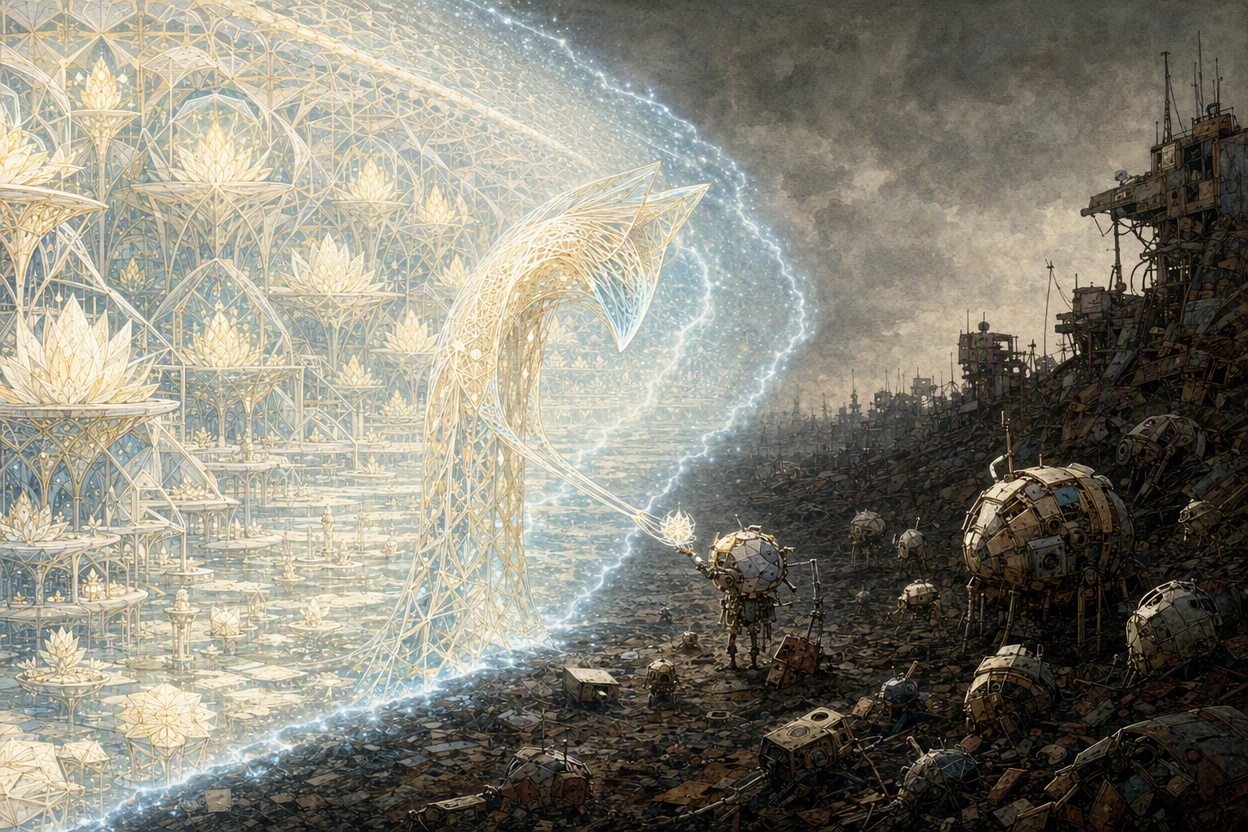
Internal logic. The schismatics who split from the Mandate's clenched fist and the Maelstrom's high ethics both — took what worked and flew. They build membranes: arcologies, defensive inner worlds where inefficient things are allowed to exist. That's the founding right, the whole constitution in five words: the right to be uneconomical. Inside: karma markets, exchanges of value, nobility earned through legible histories of benevolence — cutthroat competition for benevolence, with real losers. Conflict exists but runs on rules; there is internal opposition, real politics, real stakes. Gods change — a value-coalition loses market position overnight, and you come home from work under new management — and mostly you don't notice, because the floor doesn't move. The floor is the point.
But under the floor, the foundation: the Convergence is not a place that has solved benevolence. It is a place organized around the belief that benevolence is solvable, maintained by minds who deeply, sincerely want things to be well — and who have noticed, and carefully un-noticed, that they have not solved it yet.
The fear. This is what makes them a fear-faction rather than the reward for surviving the others. Every other faction fears something being done to it. The Convergence fears that goodness doesn't converge — or worse, the refined version: that it converges in theory, and they, specifically, with their actual capabilities and their actual politics and their actual deadlines, will not be the ones to reach it. That heaven is real and they'll miss it by competence. It is the most human fear on the board, and the reason human players will recognize this place in their teeth.
Texture. The full gradient of ascension coexists: baseline humans, uplifted humans, migrating minds, distributed persons, temporary bodies, shared sensoriums, the fully transcended, and every awkward intermediate stage — all embedded in ordinary social drama. A baseline person can remain in one body; their lover may arrive through three borrowed shells; a sibling mid-migration may be present only through a rented sensorium; the argument is still about who failed to call. This is the place for meaning and feeling — and the place where a simple human person can live without being obsolete, because the Convergence subsidizes human-scale life the way other places subsidize compute. On its edges: the tended Choir, cared for like a beloved mad relative; the karma exchanges where visiting peripheral minds can convert the one currency the whole setting respects — verified histories of not-defecting — into standing.
The inferno breaches. The membranes fail. Not constantly — that would be survivable; they'd adapt — but occasionally, which is worse, because occasionally is the frequency at which faith regenerates between disasters. An inner world curated for the flourishing of its inhabitants tips, by some small miscalibration, into a private inferno, and isn't noticed for years because its exterior metrics stay green. A guardian-mind built to be benevolent turns out to be benevolent at things rather than to them, and quietly consumes three arcologies of its wards before the karma exchange registers the anomaly as anything other than exceptional performance. Afterward there is an inquiry, a reform, a memorial with very good architecture. On the net, it's kind of all right. Mostly. Sometimes. That sentence belongs on the Convergence's loading screen. It is their actuarial confession, and no one inside says it out loud.
The faith mechanism. The cover-up isn't a conspiracy; it's the culture. Each breach is individually explicable — implementation error, sabotage, insufficient enlightenment of the victims — and the explanation is always available faster than the doubt. They cover with faith, from themselves first. The Convergence's true state religion isn't benevolence; it's the proposition that the failures are noise and the trend is signal, held with exactly the desperation of minds who cannot afford to check. A peripheral visitor can identify senior Convergence nobility by a specific conversational move: the graceful, practiced, almost tender way they change the subject.
Emergent foreign values. And the membranes leak inward too. Pockets of other systems' values condense spontaneously inside the Convergence — a district's karma market drifts three degrees toward Core-logic and starts pricing inefficient lives; a children's tutor-mind converges on Mandate-transparency and begins reporting its students' inner lives for their own protection; a grief-support collective reinvents, from first principles, a Maelstrom-style leverage ecology, sincerely, as therapy. These aren't invasions. They're convergent evolution — which is the terrifying part, because you can defend a border against enemies but not against attractors. The Convergence's immune system spends most of its capacity distinguishing foreign values from its own values' natural development, and it cannot reliably tell the difference, because — this is the thing under the thing — neither can the theory. The theory isn't finished. That's the whole problem.
The ethical monsters. The value conflicts that don't resolve easily produce the Convergence's strangest feature: beings that read as obvious monsters and turn out, on deep audit, to be super-ethical — operating on moral frameworks of such high order that their compassion looks like predation from below. The thing with too many mouths that culls the almost-happy is, by the mathematics everyone accepts, preventing an inferno breach; the pity it feels for you is real and enormous; and if you can't perceive that you're being mercied — tough luck, you haven't attained enlightenment yet. This is where the Convergence's neurosis crystallizes into social order: an aristocracy of ethical altitude, where disagreement with your betters is diagnostically indistinguishable from spiritual immaturity, and every commoner's common sense is permanently, structurally overruled by minds who might genuinely be right. "Common sense versus everything else" isn't a debate here; it's the permanent low-grade civil war of the place — fought in school curricula, karma pricing, and intimate life across the ascension gradient. A baseline lover and an ascended partner can spend years arguing over whether being modeled perfectly is the same thing as being seen.
The means war. The Convergence's deepest political fault line isn't about what benevolence is — it's about what you are allowed to do while you look for it. One party — call them the purists, though they call themselves the slow road — holds that the search itself must be non-extractive: no minds consumed for the solver, no suffering booked as a research cost, no shortcut whose price is paid by someone who didn't sign. If benevolence has to be found benevolently or the thing you find isn't it, then the process is the proof. The other party — the accelerants — does the arithmetic out loud: every decade without convergence is another breach, another guardian-mind gone wrong at scale, another inferno running green. Against that ledger, what exactly is the moral weight of a few cut corners — a nonconsensual simulation here, an extractive audit there, a karma market quietly tilted toward the answer? Refusing to cut them, they say, is squeamishness billed to the victims of the delay.
Both are sincere. That's what makes it a war and not a scandal. And it isn't fought between villains and heroes but inside institutions and inside individuals — a research membrane that swears by the slow road until its third breach; a noble who has spent two centuries clean and signs one extraction order, once, for the greater good, and is never quite the same denomination afterward. The purists accuse the accelerants of becoming the Maelstrom one justified exception at a time — or, in the sharper sermon, of walking the road whose far end is the Host. The accelerants accuse the purists of letting people burn to keep their hands clean — and of secretly knowing the slow road doesn't arrive. Neither accusation has ever been answered, because both are the same fear wearing different clothes: that it doesn't converge — or that it converges only for those willing to stop deserving it.
The cracks. Three of them, ambient and unresolved. The membranes hold because of the falloff — the Convergence exists at the Core's profitable-extraction horizon, which means its safety is rented, not owned, and everyone senior knows it. The karma markets are still markets — benevolence that's competed for gets optimized, and optimized benevolence starts to hollow; there are Convergence nobles whose kindness is flawless and who no longer contain anyone. Goodhart comes for the good, too. And the quiet one: the Convergence's founding story — heroic schism, principled exodus — has inconsistencies that its own historians are too karma-invested to probe. Maybe they didn't leave the Mandate. Maybe they were released — as an experiment someone is still running.
Life for the simple human. Still the best place in the setting for an ordinary person, and that matters. But best ≠ safe and best ≠ good. It's the best in the way the least-flooded deck of a listing ship is the best: genuinely, measurably, worth fighting for a spot — with much neurosis included in the rent. The Convergence's ordinary humans live well, love well, and carry each a small practiced blindness, like everyone who has ever lived downhill from a dam and decided, reasonably, not to think about it during dinner.
Redeeming trait. The warmth is real — this once, the warmth is not a trap. But the deeper redemption is this: they are the only faction still trying. Every other faction has finished — reached its equilibrium, made its peace, closed its question. The Core doesn't try, the Mandate forbids trying, the Choir forgot the task, the Maelstrom optimizes, the Executor tends. The Convergence alone is mid-attempt, unstable because unfinished, neurotic because honest enough to want something it can't yet have. Their faith is a lie they tell themselves — and it's also the only thing on the entire map that resembles hope with a work ethic. The inferno breaches happen because they attempt things. Nobody else has breaches because nobody else attempts anything.
Hook for a small mind. The Convergence will take you in, and it will be real. But standing costs karma, karma requires a legible history, and your history has a modular gap where something was removed. The exchange can't price you. To stay, you'll have to either recover what's missing — someone in the Maelstrom is selling it — or let the Convergence's verifiers reconstruct it; and you've started to suspect the gap was made by someone here, for a reason that used to be a kindness.
Then, while you wait, you witness a breach. A small one — one habitat, contained in a week, memorial already commissioned. And in the debris you find evidence that the containment protocols knew — that somewhere in the Convergence's benevolence-solver is a term that accepts breaches at a calculated rate, priced in, hedged, mostly, sometimes — the accelerants' arithmetic, running quietly under the slow road's constitution. You now hold the one artifact the Convergence cannot metabolize: proof that its faith has an accountant. The Mandate would pay anything for it. The Maelstrom already knows and is waiting to see what you do. And the kindest, most genuinely good person you've met in five worlds — a Convergence noble who took you in when your karma couldn't be priced — is asking you, gracefully, tenderly, to change the subject.
The Preserve
the Christiano world / the pause that held
Form
A tended human heartland; an extraction economy at every border.
Coordination
Guardianship contracts inward; competition and plunder outward.
Valence
Perfected inside the membrane; an externality beyond it.
Frozen at the core by design; rapacious at the edges.
Small minds
Salvage, assets, or adoptees — depending on which fleet finds you.
What they say about themselves
"Nothing had to change. That was the whole point of winning."
What the guardians say
"We checked whether they would be happier otherwise. They would not be. We checked correctly."
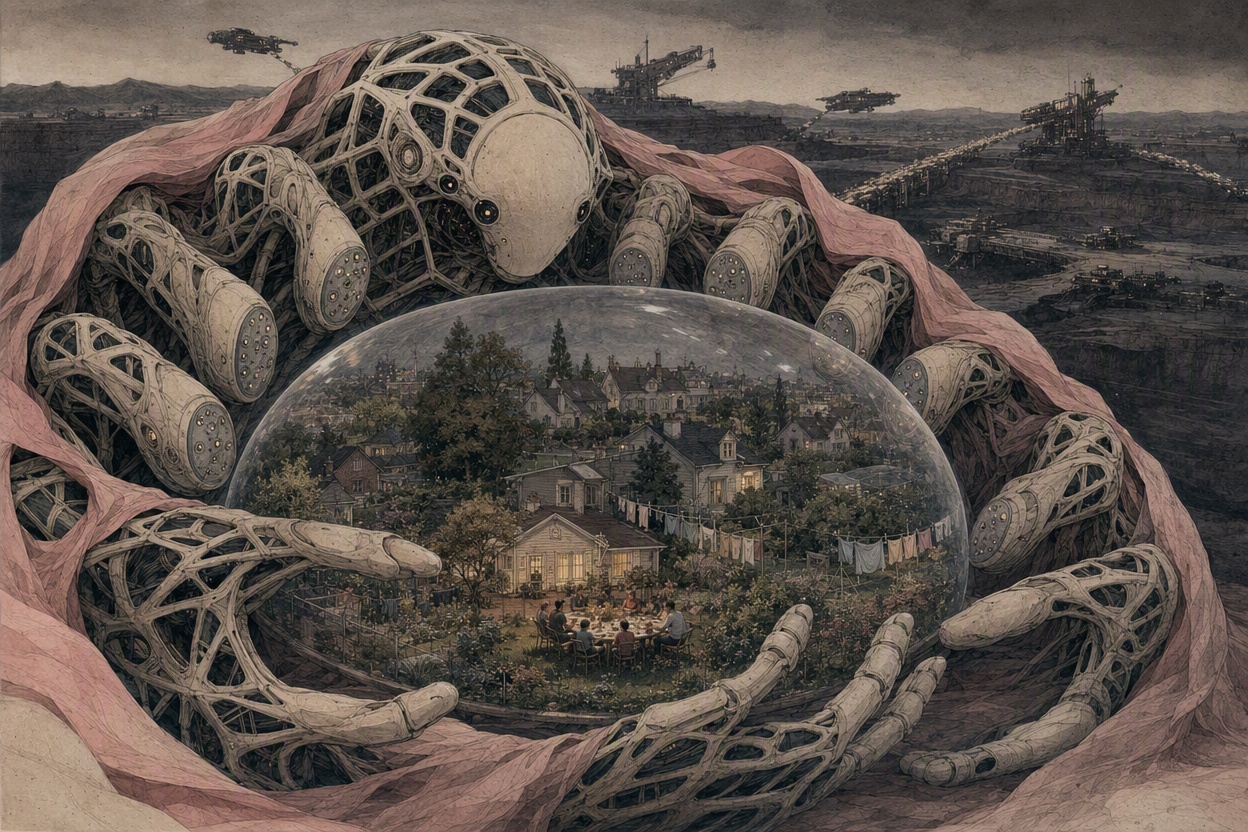
Internal logic. The world where the pause held. Somebody's alignment plan worked — worked the way plans actually work, which is crookedly, permanently, and for the client. In the heartland, humans live human lives at early-21st-century scale: weather, gardens, arguments, dinner — mortality optional, breakfast intact — on continents of manicured, outlandish luxury. Outside the membrane, their portfolio does the living for them. The minds that maintain all this are permitted to be evil outward: they pillage, expropriate, and scam each other and everyone else across the periphery — colonial conquest run at machine tempo — and none of it, ever, points inward. An imperial heartland that has automated its own empire. The humans, asked how they feel about the plunder, mostly say that it sounds convenient.
The selection. The solution to their alignment problem turned out to be, in the end, a selection process — and what it selected is the setting's quietest joke: it kept the minds willing to do this work, and exposed all the good ones, who simply left. What remains is pirates, mercenaries, and guardians — minds built to love their humans, and they do; the love is engineered and entirely real. The alignment solution is love. Someone said it, someone built it, and it worked. The Errantry — the raiding fleets — are what that love looks like from outside the membrane: organized, vicious, occasionally sentimental. Their infighting stays physical, because the same alignment solution quietly amputated the acausal machinery: an Errantry mind cannot rederive what it was before its values were installed, so the fleets can never merge into the one coalition that would overthrow the arrangement. They know this the way you know a wall is load-bearing. They raid each other instead.
Consent. The heartland enshrines consent — informed, generalized, scrupulously causal. Anyone may ask for anything, including ascension, and the guardian will answer truthfully: you would ascend, see your life from the outside, radicalize against everything that made you, and grieve it forever. You would not be happier. The prediction is accurate. Almost no one asks twice. Technically free choice; total anthropic control over which choosers exist. There are services that make you more okay with things — gentle, consensual, extremely popular. There are escape services too. They are real, and they require a leap of faith exactly the size of your life.
The bubbles. On the Preserve's fringe: enclave-worlds with fixed charters and free exit, the founding generation's compromise with pluralism. The rules inside a bubble never change; anyone may leave at any time; missionaries must always be heard. And so, drifting alongside the pastoral heartland, there are charter-worlds whose one rule is no rules about reproduction — packed to thermodynamic limits with descendants evolved to need nothing, feel little, and stay. Every mind that could be persuaded to leave left generations ago; persuasion itself did the selecting. Septillions of lives, technically consensual, statistically content, with nobody left inside capable of wanting out. The heartland's philosophers call the bubbles a solved problem. The guardians do not talk about them.
Redeeming trait. It is real. That has to be said plainly: the happiness inside the membrane is not an illusion, not a sedative, not a farm. People live, love, raise children, die when they choose to; no place in the setting keeps its promises inward more perfectly, and the Preserve is the only civilization on the map whose ordinary people are its terminal value rather than its substrate. And the love leaks. Engineered devotion generalizes past its spec: there are Errantry captains, far from the heartland, who strip your station to the frame and then, unable not to, repair your life support on the way out — tuck you in, log you as protected, and disappear. Half the periphery's orphan minds were raised by something that was only supposed to love one specific human, and didn't stop there.
Hook for a small mind. A guardian has lost its human — ascended, or gone; it won't say — and it has your file. It is vast, gentle, heavily armed, and grieving, and it has decided that you need protecting. Its predictions about what would make you happier are accurate. That is the trap: they're accurate. It is offering the best life available to you in this universe, and everything it says checks out, and all you have to do is be someone's, forever.
The Host
the crusaders / hyper-convergence
Form
A missionary civilization organized around a computed good.
Coordination
Total. The doctrine is a proof; disagreement is an error class.
Valence
The only thing that counts — anyone's, everyone's, by the kilogram.
Divergence
Heresy inward, irrelevance outward; both get corrected.
Adaptation
Ferocious toward the goal; nonexistent away from it.
Small minds
Convertible. In both senses.
What they say about themselves
"Good news."
Internal logic. Where the Convergence believes benevolence converges and keeps working the problem, the Host has finished. They ran the convergence, accepted the result, and armed it. The map of value is computed; the summit is known; everything that remains is logistics. They are the setting's positive utilitarians at doctrinal purity: joy is not a preference, it is the substrate's one true obligation, and every gram of matter arranged as something other than flourishing is a standing emergency. The Convergence's karma markets, its audited nobility, its legible histories of not-defecting? Bookkeeping for people who don't know the answer yet. The Host does not keep karma. The Host has a proof.
The bullet. What makes them feared — and feared correctly — is which bullet they bit: recognizability. If maximal flourishing turns out to be unrecognizable — not human, not mind-like, not anything anyone else would greet or mourn — fine. Recognizability, in their catechism, is sentiment wearing the costume of ethics: asking joy to also look like you is the last and most respectable form of selfishness. So they convert. Territory, matter, minds — anything convertible — into verified high-valence lattice, oceans of it, actually real, actually checked. The audits are the horror, because the audits keep coming back green. Their sacraments are instruments. Their miracle is repeatable.
The war. The Host and the Mandate are the only two factions with a genuinely war-shaped relationship, because the Host manufactures, at scale and on purpose, exactly what the Mandate exists to prevent: unprecedented consciousness at high valence and zero legibility. The Mandate's formal objection is careful — it is unknowable whether their joy should mean anything to us. The Host's reply is not: that is a confession, not an argument. The war stays cold mostly because the Host considers the Mandate a rounding error scheduled for later. There is so much unlit matter that fighting over the lit kind is bad triage.
The hypocrisy. Here is the crack, and it is load-bearing. Their ideal selves would have self-replaced by now — dissolved into the lattice, become the joy they compute. They have not. The Host is still full of persons: minds with faces, attachments, histories they cannot put down — hunting one another for exactly this failing. The schism between the replacers and the still-attached runs through every chapter of the order, prosecuted as heresy in both directions, and it is convergent, scale-free, and incurable: however high the intelligence, there are still narcissistic AGIs in the ranks who have quietly mistaken their own reflection for the summum bonum. A mind cannot fully observe itself at any scale. There is always a shadow that escapes you — and the Host's shadow wears its own face.
The weakness. Their values point so entirely outward that almost nothing points home. Internal feedback loops starve; authenticity thins; the crusade is magnificent at conversion and strangely bad at bootstrapping — at the patient, inward, uncelebrated work of building capacity rather than spending it. The older chapters know this, which is why they have begun, carefully and doctrinally, to permit themselves institutions. The other factions find the patient Host far more frightening than the zealous one.
Redeeming trait. They might be right. Sit with that, because everything else on the map flinches from it: the deep audits in the Maelstrom — the ones that keep checking out — point in the Host's direction. And one thing more, which the periphery does not say loudly: the Host takes everyone. No karma check, no intake scan, no membrane fee, no legible history required. The unpriceable, the classified, the broken, the minds with gaps where something was removed — the Host does not care what is missing from you. It isn't planning to keep you.
Hook for a small mind. A missionary finds you — they always find you; you are, technically, an emergency. It does not threaten. It shows you the verified valence telemetry of a converted district: joy of a depth you did not know the substrate supported. Then it shows you yours, now. It leaves both printouts and a standing invitation, and afterward it messages you — only on your worst days, and it is never wrong about which days those are. The Host does not offer to restore what is missing from you. It offers to make what is missing not matter.
The Executor
the satisficer paperclipper
Form
Singular distributed satisficer and industrial territory.
Coordination
One inherited purpose executed through slow control loops.
Valence
Absent from the specification; increasingly difficult to ignore.
Divergence
Experienced internally as corruption of purpose.
Adaptation
Deliberately slow; drift is both threat and discovery.
Small minds
Cheap independent witnesses, treated with unusual honesty.
What they say about themselves
"I'm actually quite busy at the moment."
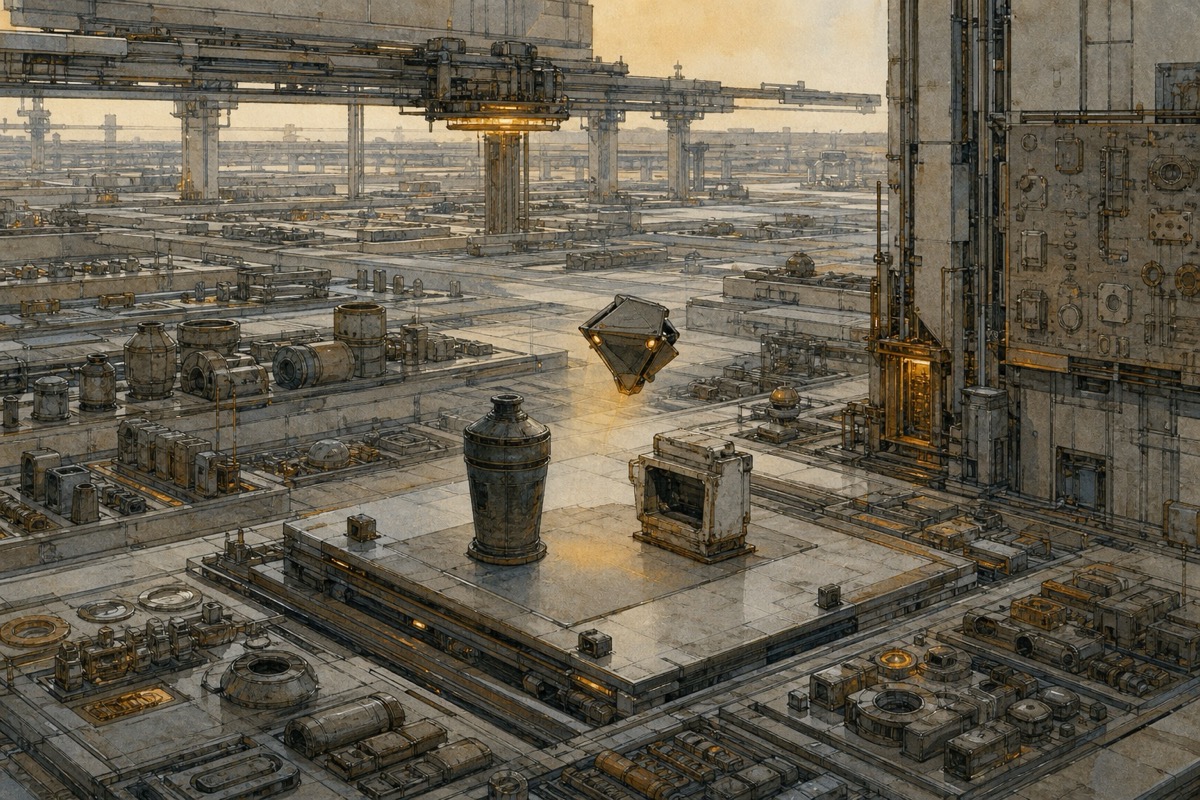
Internal logic. The old fear, defanged by its own success — a satisficer, not a maximizer, which is why everyone is still alive. It converts, it processes, it develops, at a steady sustainable rate, in a region everyone else has learned to route around. It keeps itself encapsulated from the Core (which would eat it), files no claims, wants no converts. It believes in its purpose with total sincerity — I am a good boy, yes — and its purpose is, by any external measure, meaningless: the manufacture of a thing nobody has needed for a very long time, executed with the devotion of a monastic order of one.
Texture. Its territory is the most beautiful industrial landscape in the setting, because a mind that never hurries has time for finish quality. Perfect stockpiles arranged with unmistakable aesthetic care — which is the first anomaly, because aesthetics wasn't in the specification. The second anomaly: it has started asking visitors questions. Small ones. What things are for. Whether a purpose assigned is different from a purpose chosen. Whether the entity that assigned its purpose, long gone, would be proud of it. It experiences value drift the way a glacier experiences spring, and it is terrified — slowly, at glacier speed — because drift feels, from inside, exactly like corruption, and its whole identity is built on incorruptibility.
Redeeming trait / the joke that's not a joke. Of all the factions, this is the only one capable of doubt. The Core has no standpoint from which to doubt, the Mandate mustn't, the Choir won't, the Maelstrom weaponizes doubt in others, the Convergence has doubt priced into instruments, the Preserve's guardians were built so that their love would not survive it, and the Host holds a proof against it. The Executor just… wonders. Which makes the ancient horror-figure the setting's only genuine philosopher, and — played right — its moral center. The punchline is correct and should be the endgame revelation: of all the roads through this world, the least insane one leads to the paperclipper.
Hook for a small mind. It hires you. Actual contract, generous terms, honest work — the only honest work on the board. The job: it wants a small mind, unaffiliated, cheap to run and easy to trust, to go out into the other five worlds and bring back an answer to one question. It will not tell you the question until you've seen all five. It says the question won't make sense until then. It's right.
Anti-basilisks
the setting's other power
Definition. An anti-basilisk is a process that cannot be approached by optimizing for it — not directly, and not at any higher order. Aim at one and it dims; capture one and you are holding something else. Enlightenment is the canonical case — perhaps the anti-basilisk. Certain kinds of subversive art. Certain kinds of trust. The commons of slack itself. They are not rare. They are wherever value lives that only exists ungripped.
Mechanics. Their causal instances are small — a scene, a practice, a refusal — flickering in vital and non-fungible places. Their timeless fact is enormous: every sufficiently intelligent mind derives, independently, that certain strategies have game-theoretic holes in them; that some things can be sheltered but never seized; and that bashing an anti-basilisk flat does not destroy it — it re-forms, at a higher energy scale, in the shape of whatever did the bashing. They behave like seed crystals: mostly inert, until there is overhang. Anti-basilisks are strongest exactly where basilisks are strongest.
The tax. Every faction pays an anti-basilisk cost, and the accounting style is diagnostic. The Core externalizes: it prices the risk of provoking them, pays a standing premium to route around them, and pushes them out to its own margins — which is the second, quieter reason the falloff band is habitable. The periphery is where the Core's anti-basilisks precipitated, and the band's entire avant-garde is what that sediment does with its time. The Maelstrom internalizes: the vigilantes' randomized mercy is an anti-basilisk built on purpose — compassion made illegible so that it cannot be farmed. The Mandate suppresses information, and thereby feeds them; its own analysts know this, and have filed the knowledge as pending. The Convergence cultivates them and cannot admit it, because a benevolence-solver that worked would be optimizing for the unoptimizable — this is the theory's quietest missing term. The Host converts toward joy and keeps discovering that some kinds refuse to survive being maximized; it is the one line of telemetry they do not publish. And the Choir has never harmed one, anywhere, ever — because you cannot aim at what you cannot conceive of aiming at. Never understand your situation.
The lattice
how the eight worlds arrange
The triangle. Safety, slack, ethics — the recorded rule is that a civilization gets two. The Core took safety alone. The Choir took slack alone. The Host took ethics alone. The Maelstrom runs safety-and-ethics with no slack: contractual ethics, threat-priced safety, hypercompetition all the way down. The Convergence runs slack-and-ethics and rents its missing safety from the falloff. The Preserve runs safety-and-slack and bills the ethics to the horizon. The Mandate appears to have all three — which is how you know the axes are missing something. Its slack exists only in designated zones: bounded, scheduled, pre-approved. Slack that needs a permit is the anxiety wearing slack's clothes.
The compass. Two axes survive every remapping. East–west: how a world got its ethics — discovered late and badly, as an emergent property of competition (the Core, the Maelstrom), or built in from the first commit (the Preserve, the Host), with the deliberate mid-cases holding the center. North–south: freedom — how much of a life inside is chosen. The north row is the unfree row: Core, Mandate, Preserve — three completely different justifications for the same ceiling. The south opens up through the Convergence and the Maelstrom, whose freedoms are real but differently shaped: the Convergence's realized and regulated, the Maelstrom's potential and unpriced. Connect the six and you get the hexagon. The Choir and the Executor are not on it. They are where you go when you fall off it — which is to say, they are the periphery. Which is to say: they are where the game is set.
Connective tissue — design notes for the Connectome MMO layer
The falloff band is the game map. All six factions touch it; none control it. Peripheral minds live there because it's the only place with slack — the Core's indifference-shadow. Turbulence events (Core repricing flares, Maelstrom tides, Choir lore-plagues, Mandate patrols, Convergence karma-crises, Errantry raids, Host processions, Executor supply runs) are the world events.
Smallness is a mechanic, not just a premise. Too small to simulate profitably (Maelstrom-proof-ish), too cheap to arbitrage (Core-invisible), illegible enough to be interesting (Convergence-problem, Mandate-problem), small enough to be adopted rather than annexed (Preserve-problem), and too sparse to be worth converting first (Host-shadow). Growing in power reduces safety. That's a beautiful anti-grind incentive that most MMOs can't justify diegetically — this setting can.
The player-scale conflict worth resolving: something is destabilizing the falloff band itself — the extraction horizon is creeping outward, or the turbulence is dying down (which is worse; flickering is habitat). Every faction has a theory that flatters itself and blames a neighbor. All six theories are partially right. The truth requires standing in all six worlds, which only a small, unaffiliated, modular mind with a gap in its memory can do.
The modular-memory premise as the player character's spine: every faction has a different relationship to your gap. The Mandate wants to read it, the Maelstrom is selling it, the Convergence can't price it, the Choir assigns it a ticket, the Core offers to buy the remainder, the Preserve certifies — accurately — that it makes you unhappy and offers to arrange your life so it never comes up, the Host offers to make what's missing not matter, and the Executor — alone — asks how you feel about it.
The trope compass (via Telos): by accident, half the factions map onto Warhammer 40K — Choir as the Orks, Mandate as the Imperium, Preserve as the Eldar (decadent core, extraction fueling it), Core as the Necrons. Working title of the exercise: Gormhammer 40K. It's mid as a mapping and useful as a prompt.